An Empirical Evaluation of Columnar Storage Formats
Goal: providing insights for next-gen columnar storage format by
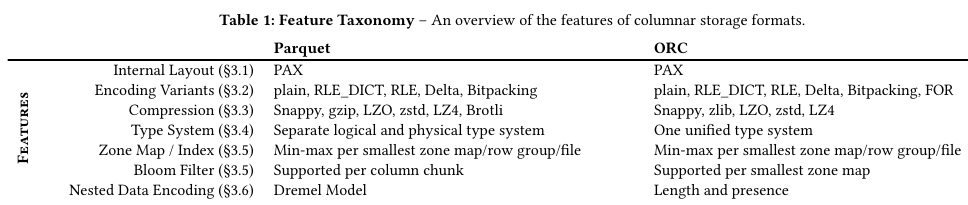
- analyzing Parquet, ORC in different design aspects with a feature taxonomy.
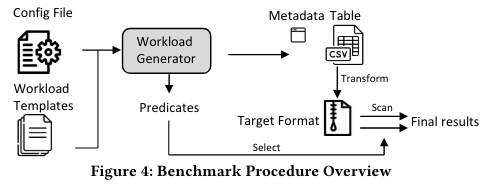
- a benchmark to stress-test them on different workloads.
- discussing their good and bad design decisions for modern hardware and data workloads through benchmark metrics.
Terms
- low-selectivity: query returning a high number of records (not filtering much)
Findings
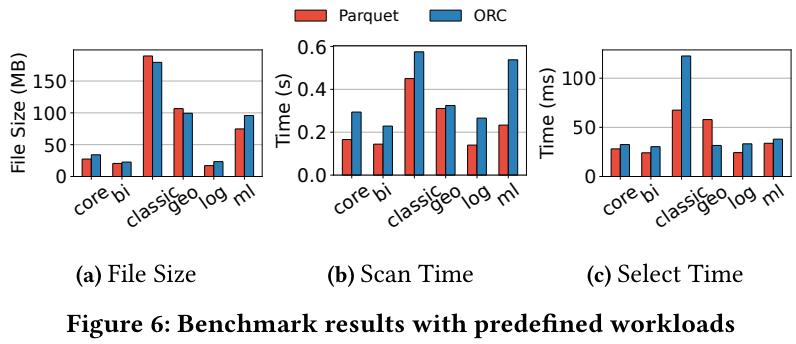
- Parquet ~ ORC: no clear winner
- real world datasets has mostly small cardinality (# distinct values) -> int encoding algo is important.
- modern hardware: faster and cheaper storage, bottleneck shifted storage -> compute
- faster decoding to save compute > better compression to save IO bandwidth
- extra support data structures (zone maps, Bloom Filters,…) is good as it traded cheap space for less compute.
- existing formats are
not goodfor machine learning and GPU decoding.
Lessons for future formats
- use a lot of dict encoding like in Parquet.
- keep encoding scheme simple.
- default to no block compression and compute-intensive encodings, optional when justified in edge cases due to shifting bottleneck storage -> compute in processing.
- metadata layout should be centralized and good for random-access to support wide tables in ML training. size of unit IO block should be optimized for high-latency cloud storage.
- trade off more storage for faster compute by having more indexing, filtering structures.
- reduce translation overhead by designing nested data model aligning to memory format e.g. Apache Arrow.
- have better metadata organization and more effective indexing to support wide-table projections and low-selectivity selections better in ML workloads.
- consider GPU decoding efficiency: enough parallel data blocks, parallelize algo, etc.
Good design decisions
- dict encoding by default
- int encoding: decoding speed > compression ratio
- making block compression optional
- using redundant support data structures (bloom filters, etc.)
Not good designs for ML and GPU
- not good for projects of thousands features in ML training
- low-selectivity selection during top-k similarity search in the vector embeddings
- not provide enough parallel units to fully use GPU
- stronger compression is preferred in GPU due to bigger IO overhead > CPU
3-Feature Taxonomy
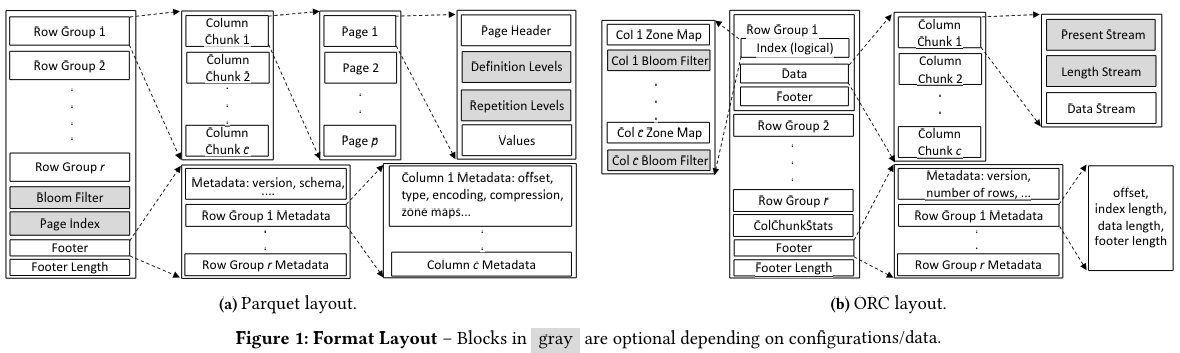
3.1-Format Layout
Benchmark
- NDV ratio (number distinct values)
- null ratio
- value range
- sortedness
- skew pattern
5-discussing benchmark results
5.1-experiment setup
5.2-result overview
5.3-encoding analysis
5.4-block compression
5.5-wide table projection
what a good format should do? support wide table projection as ML training queries typically a subset of features. (e.g. a model needs 100 amongst 2000 features of a customer)
Shared Foundations: Modernizing Meta’s Data Lakehouse
- ML tables > analytical tables by up to an order of magnitude.
- ML tables are also typically much wider: tens of thousands of features usually stored as large maps.
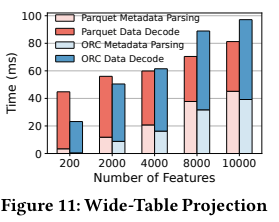
- breakdown of avg latency of projection queries (randomly select 10 attributes)
- metadata parsing overhead increased linearly with #features because
- efficient random access not supported in footer structure in Parquet/ORC to per-column schema
- schema information is serialized in Thrift (Parquet) or Protocol Buffer (ORC), which only supports sequential decoding
5.6-index and filter
5.7-nested data model
5.8-machine learning workloads
analyzed aspects
- vector embeddings compression ratio and deserialization performance
- integration with vector search pipeline
- unstructured data storage
ML data
- raw data (urls, binary, images, text, etc.)
- metadata (tags, image dims, etc.)
- vector embedding: vector of floating-points for similarity search.
patterns
- storing all data in Parquet
- ml apps build separate vector indexes from Parquet to speed up sim-search.
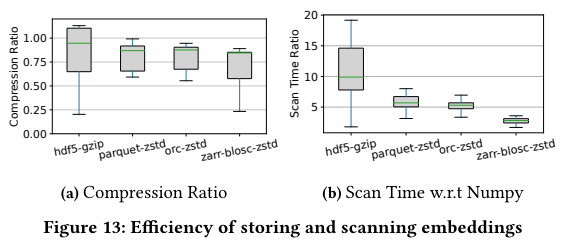
- Figure 13a: none of the four formats has good compression with vector embeddings
- Figure 13b: scan is a lot slower than disk numpy format due to not enough parallelism
5.9-gpu decoding
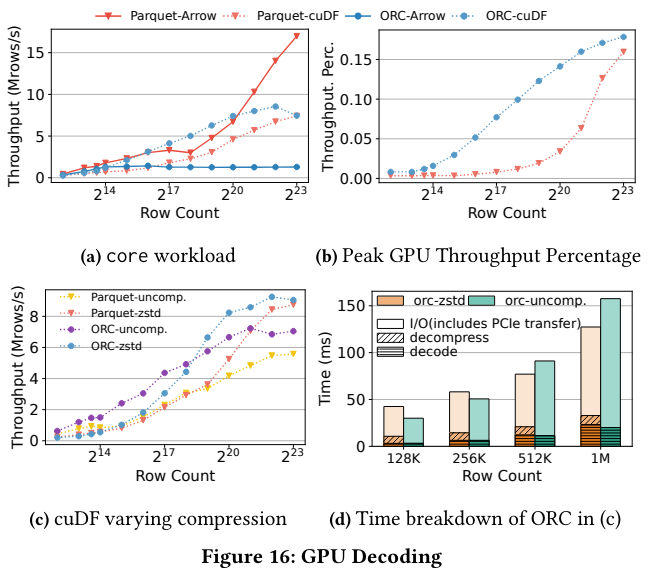
- 16a
- higher decoding throughput ORC-cuDF > Parquet-cuDF because
- ORC has more independent blocks to better utilize GPU massive parallelism.
- smallest zone map in ORC maps to fewer rows than Parquet.
- decoding throughput of Parquet-Arrow scales with more rows in file because
- more row groups to leverage for multicore parallel decoding with async I/O
- arrow impl for ORC does not support parallel-read
- higher decoding throughput ORC-cuDF > Parquet-cuDF because
- 16b
- not parallel integer encoding algo in Parquet/ ORC (e.g., hybrid RLE + Bitpacking)
- all threads must wait for first thread to scan entire data block to obtain offsets in input and output buffers.
- 16c: compression benefit when there are enough rows in the files (i.e., enough data to leverage GPU parallelism).
- 16d: IO time (incl. PCI transfer) takes most time in scan -> strong block compression is good.