Building a database on S3
Summary
in scope
- building a basic database with different consistency levels on S3
out of scope
- strict consistency and db-style transactions (not useful in web-scale apps)
what are the advantages of building on S3?
- easier to control security (3.6)
- easier to control and tune for different levels of consistency
- easier to provide latency guarantees (upper bounds for all read write requests)
what are the limitations?
- cannot do chained IO to scan through several pages on S3 -> important for S3 db algo design.
- in theory, it can take undetermined amount of time before updates of one client are visible to others.
Problems
(answers at the end)
- problem: reading from S3 at best at 100ms (100x-1000x local disk) is too slow for a database.
- problem: low bandwidth with small objects.
- problem: S3 uses
last update winspolicy. - problem: the system is eventually-consisten and it can take undetermined amount of time before updates of one client are visible to others.
- problem: a PU queue can only be checkpointing by 1 client at a time.
Terms
- checkpointing: applying log records of updates on SQS to S3 pages.
- consistency
- strict
- monotonic reads
- monotonic writes
- read your writes
- write follows read
- eventual
- isolation: snapshot isolation, backward-oriented concurrency control (BOCC)
- BOCC: global counter
Details
how many levels of consistency is designed?
- naive
- basic
- monotonicity
- atomic
what is the Naive approach?
- commit op writes all dirty pages directly back to S3
- can have lost updates -> cannot achieve even
eventual consistency
basic
- supports eventual consistency
monotonicity
atomicity
how different levels of consistency affects latency and cost?
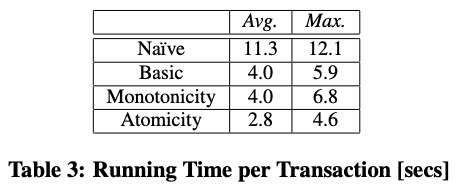
how to deal with concurrent clients update records on the same page?
- coordinate the updates -> limit the scalability
coordinate updates = synchronize updates
s3 vs disk
- pros: can support ~indefinite num clients, way faster throughput not reducing with num clients.
- cons: 100x-1000x worse latency for read and write.
why only 1 PU queue can be used at a time?
commit protocol
What happens if a client crashes during a commit?
- client resends all log records when it restarts.
- some log records are sent twice but not a problem since they are idempotent.
- indeterminism still possible: an update-ts1 might overwrite update-ts2 happening after it.
why are log records idempotent?
- there are 3 types of log records: insert, delete, update so we look at them each
- (insert, key, payload) -> if applied again, the same key is inserted so idempotent
- (delete, key) -> if applied again, the same key is deleted so idempotent
- (update, key, afterimage) -> if applied again, the same key is updated to same value so idempotent
- note that idempotent is not consistent in concurrency scenarios so
update-ts1can still overwriteupdate-ts2when update-ts1 is reapplied. ts1 happens before ts2 in reality. this problem is calledindeterminism
what is a redo log record? how is it different from undo?
- redo captures the change and new value for roll-forward in case of a crash.
- undo captures the old value before the change for roll-back.
- example
a table user with userid=1, username=before
a SQL update executed in txn T1 `UPDATE user where userid=1 SET username='after'

redo: txn=t1, table=user, rowid=1, column=username, value='after', action=update
undo: txn=t1, table=user, rowid=1, column=username, value='before', action=update
in what case atomicity is violated?
- a client issues txn T1: where it updates table1 and table2.
- after table1 update is done, the
record managersends update1log recordtoPending Updatequeue. - the checkpoint worker applies this log record to table state on S3.
- client crashes.
- the state on S3 now is in the middle of transaction.
- client might not come back and the other log record might not ever be updated.
- so this txn is not atomic.
how to ensure atomicity?
todo
what happens if a PU queue is checkpointed by multiple clients?
- lost updates.
- Let’s say there are 2 client1 and client2 checkpointing a PU queue with 2 log records {r1, r2}
- update r1 writes table1 value from 0 to 1
- update r2 writes table1 value from 1 to 2
- client1 takes r1, client2 takes r2
- client2 updates first, then client1 updates
- table1 now at value 1 instead of 2 as we wanted (r2 happens after r1).
what is the protocol to synchronize concurrent update transactions then?
what is a checkpoint strategy? what are the options? what is proposed by the paper?
- determine by whom and when to checkpoint.
- 4 options for the checkpointer of a Page X
- reader of X
- writer: a client who just committed updates to X
- watchdog: a process which periodically checks PU queues
- owners: X is assigned to a specific client which periodically checks PU queue of X
- proposed: readers and writers of X because
- they need to work in X anyway to avoid extra resource needed.
- owners might be offline for an undetermined amount of time.
Transactional properties
Which specific transactional properties this section provides implementation strategies for?
- atomicity and - all client-side consistency levels - monotonic reads - monotonic writes - read your writes - write follows readWhich ACID properties are impractical to achive?
- Isolation and Strong Consistency.Why is strong consistency considered different from client-side consistency?
- Strong consistency refers to the whole system, every clients scope. This guarantees that every clients agree on a global order of operations. This often means Linearizability`` for operations and `Serializability` for transactions. - Client-side consistency refers to only 1 client and its sequence of operations. This guarantees only the consistency for one client operations, not globally for every clients.What is the mechanism to ensure atomicity?
``` 3 steps for commit operation. Step 2 and 3 can be async. 1. send all log records to ATOMIC queue. Commit record sent last. 2. Send all log records to PU queues. 3. Delete commit record from ATOMIC queue. ```Answers
- solution: aggresive caching.
- solution: batching objects into big pages.
- solution: all commit protocol ensures there is enough time (seconds) between updates to same objects.
- solution: the eventual time can be capped by checkpointing. Tuning checkpoint interval (trade-off increasing cost ~ checkpoint more frequent) to e.g. 10 seconds -> all clients must see updates after 10 seconds.
- solution: using multiple PU queues.